Home Blog

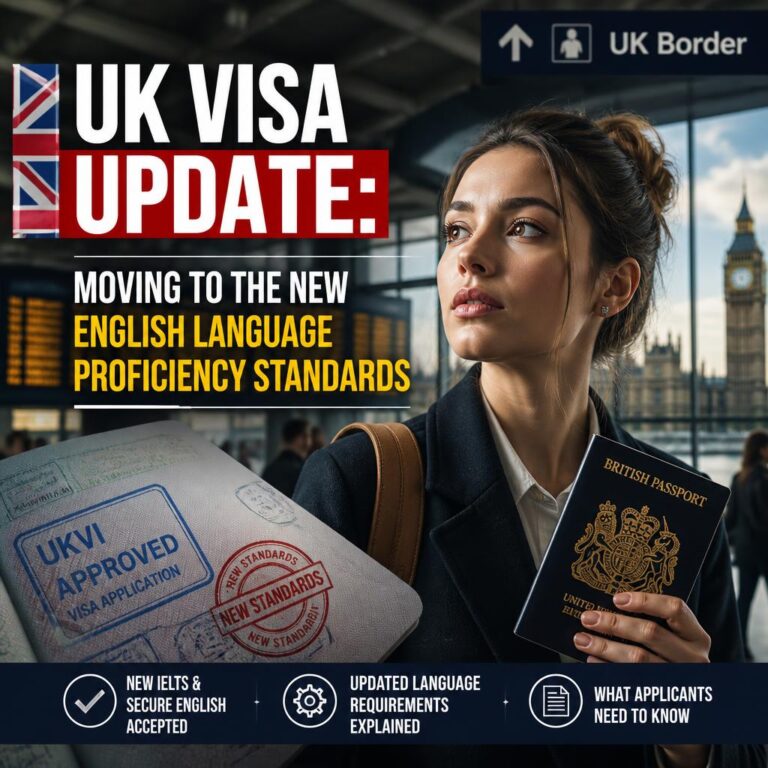
UK Visa Update: Moving to the New English Language Proficiency Standards

Published: May 22, 2026

Category: UK & Europe News

Author: Editorial Team

The Home Office has officially introduced stricter integration measures across its primary skilled migration routes, creating a major shift for international professionals and corporate sponsors alike. Under recent immigration updates, the baseline language requirements for multiple economic visa categories have formally increased, making comprehensive pre-flight preparation more critical than ever. For applicants navigating these routes, understanding how to satisfy the elevated UK visa English requirement is now the key to avoiding immediate structural delays or visa refusals.

According to official guidance from the UK Home Office, this transition is designed to ensure that foreign nationals can communicate confidently, operate independently, and integrate effectively into British workplaces and wider national life. To satisfy the updated UK visa English requirement, applicants must now demonstrate upper-intermediate language proficiency, moving away from basic conversational thresholds used in previous years.

Meeting the New UK Visa English Requirement Standards

The current framework has officially elevated the minimum mandatory language baseline from the intermediate B1 level to the upper-intermediate B2 standard on the Common European Framework of Reference for Languages (CEFR). This shift impacts reading, writing, speaking, and listening capabilities uniformly across the board.

1. Affected Immigration Routes

The higher B2 language standard applies to all new visa applicationsโ€”including in-country switches from separate temporary categoriesโ€”for the following pathways:

  • Skilled Worker Visa: The main route for professional corporate hires, engineers, healthcare specialists, and technical talent.
  • Scale-up Worker Visa: Tailored for fast-growth companies attracting specialized international professionals.
  • High Potential Individual (HPI) Visa: Designed for global graduates from prestigious elite universities worldwide.

2. What Does the B2 Fluency Level Actually Mean?

The CEFR defines a B2 user as an upper-intermediate, independent communicator. In a professional environment, an applicant must be fully capable of understanding the main ideas of highly complex, technical texts within their specific field of expertise. Additionally, they must display a level of conversational spontaneity and fluency that allows for natural, everyday interactions with native English speakers without causing strain or misunderstanding for either party.

Approved Testing Routes and Crucial Exemptions

Unless you qualify for a strict categorical exemption, you must successfully pass a Secure English Language Test (SELT) across all four core components: speaking, listening, reading, and writing. Your test must be booked through an officially recognized, Home Office-approved assessment provider, such as IELTS for UKVI, Pearson PTE Academic UKVI, or Trinity College London.

However, the immigration rules do preserve specific exemptions for select applicants:

  • Majority English-Speaking Countries: Citizens of nations like the USA, Canada, Australia, and New Zealand do not need to take a test.
  • Academic Degrees: If you hold a bachelorโ€™s, masterโ€™s, or PhD degree taught entirely in English at a UK university, you automatically meet the standard. For overseas degrees taught in English, your credentials must be formally verified for equivalence by Ecctis, the UK’s official qualifications body.
  • Grandparented Extensions: If you are already inside the UK on a Skilled Worker visa and met the historic B1 standard when you originally applied, you do not need to meet the higher B2 standard when simply extending your visa on the exact same route.

Long-Term Planning: The Road to Settlement (ILR)

Looking past temporary work permits, the governmentโ€™s landmark Earned Settlement reforms have formally extended this language mandate to long-term residency applications. Following the newest Statement of Changes to the Immigration Rules, foreign nationals seeking Indefinite Leave to Remain (ILR) across major categories will also see their language requirement increase to the B2 level. Because moving between these proficiency tiers takes an estimated 200 hours of structured study, mapping your language pathway early is vital to securing permanent residency without interruption.

With corporate sponsorship parameters tightening, employers must expect longer recruitment lead times and potential increases in initial talent verification costs. Before initiating a new corporate transfer or applying to switch visa paths inside the UK, make sure to cross-reference your specific professional credentials. You can access our comprehensive compliance guides or reach out to a verified immigration lawyer through our official global resource directory to review your application’s technical alignment.
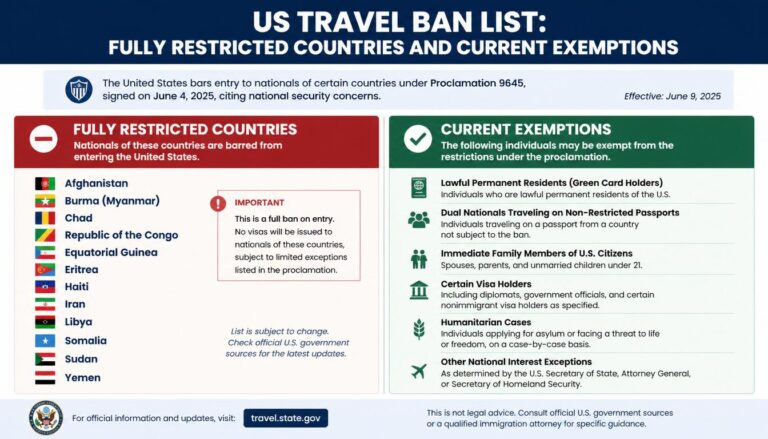
US Travel Ban List: Fully Restricted Countries and Current Exemptions

The landscape of global migration is adjusting to structural updates. The Department of Homeland Security (DHS) has issued refined guidance regarding entry restrictions, emphasizing rigorous identity verification and background screening protocols for individuals seeking entry into the United States.

For families, international students, and skilled workers looking to map out their travel plans, understanding the explicit boundaries between full restrictions, partial limitations, and legal exemptions is essential to avoiding critical delays.

The Two-Tiered Policy Framework

The current framework segments affected nations into distinct restriction levels, primarily isolating high-turnover non-immigrant streams and baseline immigrant applications.

Full Entry Restrictions

Under standard security protocols, nationals from the following jurisdictions face broad suspensions across both immigrant and non-immigrant visa pathways:

  • Afghanistan, Burkina Faso, Burma (Myanmar), and Chad.
  • Laos, Libya, Mali, Niger, and Syria.
  • Somalia, Sudan, South Sudan, Yemen, and individuals holding travel documentation endorsed by the Palestinian Authority.

Partial Entry Restrictions

For a separate tier of nations, restrictions remain highly specific. These regulations primarily target immigrant visa processing or place temporary freezes on major temporary visitor categories, including standard B-1/B-2 visitor visas, F-1 student streams, and J-1 exchange programs:

  • Angola, Benin, Burundi, and Cรดte d’Ivoire.
  • Cuba, Dominica, Gabon, and The Gambia.
  • Nigeria, Senegal, Tanzania, Togo, and Venezuela.

Valid Exemptions: Who Can Legally Enter?

Despite the far-reaching nature of these directives, federal guidelines maintain ironclad exemptions designed to protect specific travel groups and existing legal statuses:

  • Lawful Permanent Residents: Active Green Card holders are fully exempt from travel suspensions.
  • Valid Prior Visas: Visas officially stamped and validated prior to the enforcement date remain legally active, though travelers should anticipate detailed screening at Ports of Entry.
  • Dual National Status: Individuals possessing a valid passport from a non-banned country who choose to travel exclusively on that document are exempt.
  • Official Diplomatic Travel: Foreign officials holding active A-1, A-2, or G-class visas face no interruption to their entry protocols.

Professional Guidance for Affected Travelers

If your country of origin faces restrictions, immediate proactive measures are highly recommended. Always pause international travel if you are already inside the U.S. on a temporary status from an affected nation, as a departure may trigger a long-term application lock. Furthermore, applicants looking to bypass restrictions should coordinate with qualified legal counsel to investigate the stringent requirements for a National Interest Waiver.

USImmigration #TravelBan #USCIS #BreakingNews #VisaExemptions

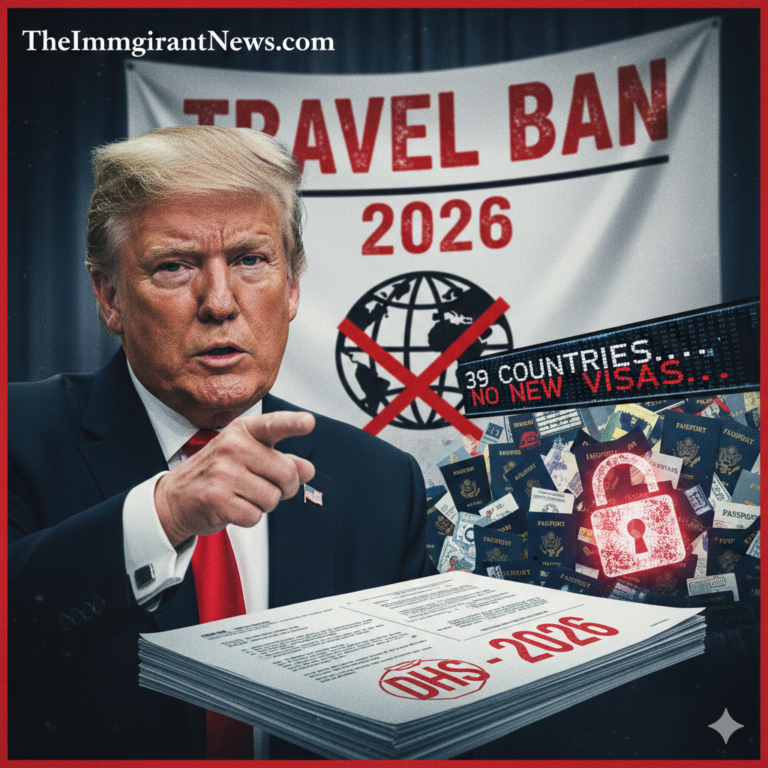
US Travel Ban 2026: Full List of 39 Restricted Countries and Exemptions

The landscape of American immigration has shifted dramatically. As of January 1, 2026, Presidential Proclamation 10998 has officially expanded the U.S. travel restrictions to include a total of 39 countries and territories.

Building on the previous measures from 2025, this new executive action cites “severe deficiencies in screening and vetting” as the primary reason for the expansion. For families, students, and workers from the impacted nations, the rules are now significantly more rigid.

The Two-Tiered Ban System

The 2026 policy divides affected nations into two distinct groups: Full Restrictions and Partial Restrictions.

1. Full Entry Restrictions (19 Jurisdictions)

Nationals from these countries are suspended from entry as both immigrants and non-immigrants. Effectively, this means no new green cards, tourist visas, or student visas will be issued to citizens of these nations unless a rare individual waiver is granted.

  • Existing (from 2025): Afghanistan, Burma (Myanmar), Chad, Republic of the Congo, Equatorial Guinea, Eritrea, Haiti, Iran, Libya, Somalia, Sudan, Yemen.
  • Newly Added for 2026: Burkina Faso, Laos, Mali, Niger, Sierra Leone, South Sudan, Syria.
  • Special Designation: Individuals using travel documents issued or endorsed by the Palestinian Authority (PA).

2. Partial Entry Restrictions (20 Countries)

For these nations, the ban is focused on immigrant visas and specific high-volume non-immigrant categories including B-1/B-2 (Visitor), F/M (Student), and J (Exchange) visas.

  • List of Nations: Angola, Antigua and Barbuda, Benin, Burundi, Cรดte d’Ivoire, Cuba, Dominica, Gabon, The Gambia, Malawi, Mauritania, Nigeria, Senegal, Tanzania, Togo, Tonga, Turkmenistan*, Venezuela, Zambia, Zimbabwe.
  • Note: Turkmenistan is only restricted for immigrant visas; non-immigrant B, F, M, and J categories were recently unblocked.

Critical Exemptions: Who Can Still Enter?

The 2026 proclamation includes several narrow categories that are exempt from the suspension. If you fall into one of these groups, the ban does not legally bar your entry:

  • Lawful Permanent Residents: Green card holders remain exempt.
  • Existing Visa Holders: Visas issued before January 1, 2026, will not be revoked. However, expect extreme scrutiny at Ports of Entry.
  • Dual Nationals: If you hold a passport from a non-banned country and are traveling on that document, you are exempt.
  • Diplomatic Travel: Holders of A-1, A-2, C-2, G-1, G-2, G-3, and G-4 visas.
  • Special Sporting Events: Athletes and essential support staff for the 2026 FIFA World Cup and upcoming Olympics.

Warning: Previous exemptions for immediate relatives (spouses and children of U.S. citizens) and international adoptions have been eliminated in this 2026 update.


What to Do If You Are Impacted

If you are a national of one of the 39 countries listed above and do not yet have a valid visa, the path forward is difficult.

  1. Seek a National Interest Waiver: Consular officers have the discretion to grant waivers if you can prove your entry is in the U.S. national interest or that your denial would cause undue hardship.
  2. Pause International Travel: If you are currently in the U.S. on a valid visa from a banned country, do not leave. If you depart, you may be unable to renew your visa or re-enter.
  3. Consult Legal Counsel: Because these policies are being challenged in federal courts, the rules may change weekly.

The Immigrant News will continue to monitor the Department of Stateโ€™s visa issuance data for any shifts in these restrictions.